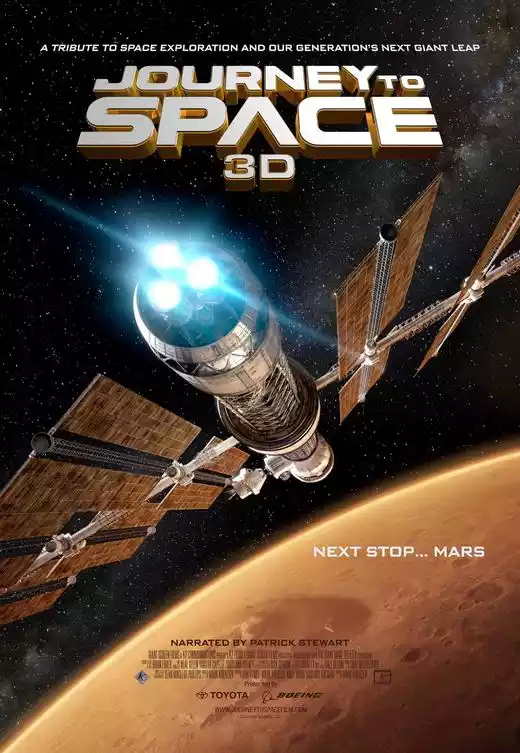
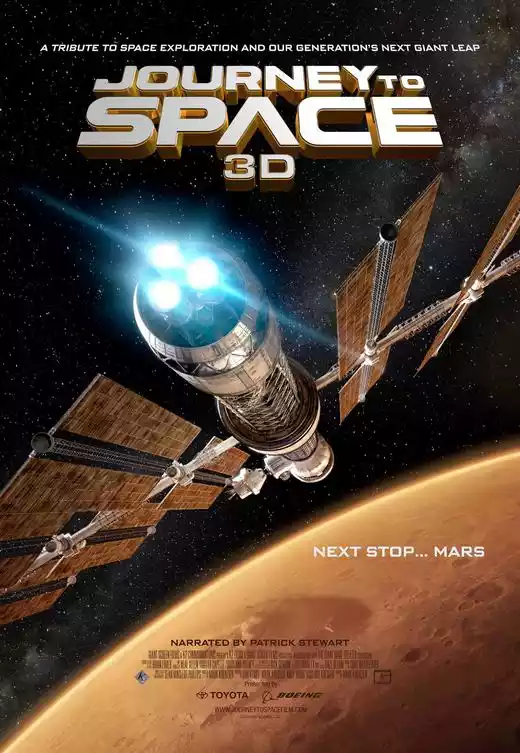
太空之旅 Journey to Space(EN)Subtitles
| SRT Subtitles download |
1 00:00:54 We are the species that explores,
2 00:00:57 that fashions vesselsto carry us into the unknown.
3 00:01:02 We sailed the planet of our birth,
4 00:01:05 saw its wonders and made it home.
5 00:01:08 And it wasn't enough.
6 00:01:10 We built flying machines
7 00:01:13 to explore higher, faster, farther.
8 00:01:18 Heroes flew them beyondwhat once seemed possible.
9 00:01:21 And it wasn't enough.
10 00:01:28 In time, we created special craft
11 00:01:31 that would ferry usto the edge of space and back.
12 00:01:40 And as always, there were the few...
13 00:01:42 brave and brilliant souls...
14 00:01:44 ready to guide this vessel through dangers
15 00:01:46 in the name of discovery.
16 00:02:21 Using the space shuttle,
17 00:02:24 we built an unprecedentedoutpost in the heavens.
18 00:02:32 We learned in the weightless worldof the International Space Station,
19 00:02:37 peered into the dark nightof an infinite universe.
20 00:02:41 And it wasn't enough.
21 00:02:45 Now we are fashioning vessels to set off
22 00:02:48 on our greatest adventureof exploration ever:
23 00:02:51 to Mars and beyond.
24 00:03:11 Who knew that 30 yearswould go by so quickly?
25 00:03:18 That these unique spacecraft
26 00:03:20 would leave in their wakea public captivated
27 00:03:23 by their achievements...
28 00:03:28 ...a planet poised at the brink
29 00:03:31 of deep-space exploration.
30 00:04:09 As an astronaut, I definitely felt
31 00:04:12 I was saying good-bye to a long-timefriend when the last shuttle landed.
32 00:04:34 My name is Chris Ferguson.
33 00:04:37 I was lucky enough to flyon three shuttle missions,
34 00:04:39 one of them on Endeavour.
35 00:04:41 So it's no surprisethat I wanted to be there
36 00:04:43 when she was headed for her new home
37 00:04:46 at the California Science Centerin Los Angeles.
38 00:04:51 From the look of it,you might think it took
39 00:04:54 as much engineering to get Endeavour
40 00:04:55 through the streets of L.A.as launching her into orbit.
41 00:05:17 Watching the orbiter squeezethrough the city neighborhoods,
42 00:05:20 you could feel just how much theshuttle had come to stand for,
43 00:05:23 almost as if it had takenall of us into space.
44 00:05:36 I sure don't want the world to forget
45 00:05:38 this remarkable spacecraftand those who built it,
46 00:05:40 and the legacy they left,
47 00:05:43 lighting the way towardour next frontier in space.
48 00:05:48 They're coming.
49 00:05:49 The shuttle was the firstreusable piloted spacecraft.
50 00:05:53 And its engineering and softwarewas so bulletproof,
51 00:05:57 it could be flown by computersless powerful than today's smartphones.
52 00:06:01 Two hundred.
53 00:06:05 One hundred.
54 00:06:06 At 235 miles per hour,
55 00:06:08 the shuttle hadthe fastest touchdown speed
56 00:06:11 of any flying vehicle ever built.
57 00:06:14 When you glide 220,000 poundsof spacecraft
58 00:06:18 to a no-power landing,the gear hits with a major whomp.
59 00:06:24 Touchdown.
60 00:06:29 Conceived in the 1970s
61 00:06:31 as a kind of winged delivery truck
62 00:06:34 to build a United Stateslow-Earth-orbit space station...
63 00:06:37 Give you a payload I.D. of one.
64 00:06:39 ...the shuttle actually flew
65 00:06:41 more than a decade beyondoriginal expectations.
66 00:06:47 It was the shuttle programthat allowed us to do
67 00:06:50 real ongoing work in space,
68 00:06:53 to put delicate equipmentinto orbit and to retrieve
69 00:06:56 and fix that equipmentwhen things went wrong.
70 00:07:52 Orbiters deployed, retrieved and repaired
71 00:07:54 over a hundred scientificand communications satellites.
72 00:07:59 And no missions were moreimportant to our understanding
73 00:08:02 of deep space than thefive flights, beginning in 1993,
74 00:08:05 made to repair and upgradethe Hubble Space Telescope.
75 00:08:12 Hubble affirmative.
76 00:08:14 You have a go for release.
77 00:08:24 I think history will viewthe Hubble Space Telescope
78 00:08:27 as one of the crowningachievements in astronomy.
79 00:08:36 The Hubble gave us an unprecedentedview of both our closest neighbors
80 00:08:40 and of galaxiesunimaginably far from our own.
81 00:08:50 Further space telescopeinvestigations have revealed
82 00:08:54 that the number of Earth-like planetscapable of harboring liquid water
83 00:08:58 is vastly greater thanscientists once calculated.
84 00:09:42 In 1995, the shuttles began
85 00:09:44 a new era ofinternational space exploration
86 00:09:47 when Atlantis docked, for the first time,with the Russian MIR station.
87 00:09:51 Eight inches.
88 00:09:53 One-oh-point-oh-seven.
89 00:09:56 One-oh-six.
90 00:09:58 Four inches.
91 00:10:00 Now. We have capture.
92 00:10:08 Altogether, the orbitersmade 11 trips to visit Mir.
93 00:10:12 These missions established a levelof international cooperation and expertise
94 00:10:16 that continues to this day.
95 00:10:21 Though MIR no longer orbits Earth,
96 00:10:23 the shuttle proved itselfas a brilliant reusable tool
97 00:10:27 that allowed us to live,build and do science
98 00:10:30 in the weightless environment of space.
99 00:10:58 But the shuttles' truest legacy crossesthe sky above us every 90 minutes.
100 00:11:06 The International Space Stationcould never have been built
101 00:11:09 without the shuttles' payloadand space-walk capabilities.
102 00:11:16 Space shuttles and RussianSoyuz and Proton rockets
103 00:11:20 made more than 40 flights to constructthe International Space Station...
104 00:11:23 a true engineering miracle.
105 00:11:30 All three of my Orbiter missionswere to the ISS.
106 00:11:40 Modules built by NASA partners in Asia,
107 00:11:44 Europe and North America,came together above Earth,
108 00:11:47 over a period of 13 years,to create a floating world
109 00:11:51 longer than a football field
110 00:11:53 and with more living spacethan a six-bedroom house.
111 00:12:00 A typical ISS missionrequires an astronaut
112 00:12:04 to live six months onboard.
113 00:12:06 But some crew members will spend a year
114 00:12:09 learning even moreabout the very real physical
115 00:12:12 and psychological stresses
116 00:12:14 of long-term separation from Earth.
117 00:12:20 These missions and the 15 nations
118 00:12:23 that designed, built and crew the ISS,
119 00:12:25 forever changed space exploration
120 00:12:28 into a cooperative international program
121 00:12:30 and made a true homeand science lab like no other.
122 00:12:34 # Wash away my troubles #
123 00:12:36 # Wash away my pain #
124 00:12:38 # With the rain in Shambala... #
125 00:12:41 ISS system designsand scientific experiments
126 00:12:45 have spawned a multitudeof Earth-useful discoveries,
127 00:12:48 including breakthroughs
128 00:12:49 in water purificationand robotic microsurgery.
129 00:12:53 But most important, the ISSis our springboard to the future,
130 00:12:57 giving us the knowledge and confidence
131 00:13:00 to sustain human lifeas we explore deep space.
132 00:13:04 # Everyone is helpful #
133 00:13:07 # Everyone is kind... #
134 00:13:08 Life on ISS is all about gettingthe job done and having a little fun.
135 00:13:13 # Everyone is lucky #
136 00:13:15 # Everyone is so kind #
137 00:13:17 # On the road to Shambala... #
138 00:13:19 And nationality is mostly
139 00:13:22 about tasting each other's food.
140 00:13:24 # Yeah, yeah, yeah, yeah, yeah #
141 00:13:27 # Ah, ooh, ooh, ooh #
142 00:13:30 # Ooh, ooh, ooh, yeah #
143 00:13:32 # Yeah, yeah, yeah, yeah, yeah... #
144 00:13:36 Through three decadesof camaraderie and dedication,
145 00:13:40 355 people rode the shuttle into history.
146 00:13:43 They circled the Earth 21,000 times,
147 00:13:47 and it all came to seem routine....
148 00:13:50 until it wasn't.
149 00:13:51 ...one minute, 15 seconds.
150 00:13:53 Velocity 2,900 feet per second.
151 00:13:54 Altitude nine nautical miles.
152 00:13:56 Downrange distance seven nautical miles.
153 00:13:58 This shuttle mission will launch...
154 00:13:59 My God!
155 00:14:01 There's been an explosion.
156 00:14:03 Flight controllers here lookingvery carefully at the situation.
157 00:14:07 Obviously a major malfunction.
158 00:14:09 In two accidents that stunned the world,
159 00:14:13 we lost 14 astronauts.
160 00:14:15 It was a sobering reminderthat every space flight
161 00:14:19 is charged with potential danger.
162 00:14:22 They had a hunger to explore the universe
163 00:14:24 and discover its truths.
164 00:14:26 They wished to serve, and they did.
165 00:14:31 They were pioneers.
166 00:14:33 The future doesn't belongto the fainthearted.
167 00:14:36 It belongs to the brave.
168 00:14:44 The world mourned, but pushed on,
169 00:14:47 because the accomplishmentsof the space shuttle
170 00:14:50 and the International Space Station
171 00:14:52 were full of life-changing promise.
172 00:14:56 In memory of our lost heroes,the global space community
173 00:15:00 pulled together to reignitethe future of both programs.
174 00:15:06 Who could askfor a better ending to my career
175 00:15:08 as an astronaut than getting to flythe last shuttle mission on Atlantis,
176 00:15:12 and a final visit to the ISS.
177 00:15:22 Atlantis launch director,air to ground one.
178 00:15:25 Atlantis go.
179 00:15:27 And so, for the final time, Fergie, Doug,
180 00:15:31 Sandy and Rex, good luck, Godspeed,and have a little fun up there.
181 00:15:35 We're not ending the journey today, Mike,
182 00:15:37 we're completing a chapter ofa journey that will never end.
183 00:15:40 You and the thousands of men and women
184 00:15:41 who gave their hearts,souls and their lives
185 00:15:44 for the cause of exploration,have rewritten history.
186 00:15:47 Let's light this fire one more time, Mike.
187 00:16:56 Though the shuttles no longer fly,
188 00:16:59 I never miss a chance to see Atlantisat the Kennedy Space Center.
189 00:17:06 But I came to KSC to get a lookat the next big step
190 00:17:10 in deep-space exploration,and it's called Orion.
191 00:17:21 Here, in the giant operationsand checkout clean room,
192 00:17:24 the new Orion multi-purposed crew vehicle
193 00:17:26 is coming together.
194 00:17:28 What an impressive vehicle.Look at that... it's beautiful.
195 00:17:34 It's gorgeous. I'd love to climb in there.
196 00:17:36 Orion is a true deep-spaceexploration craft,
197 00:17:39 designed to carry astronauts of the future
198 00:17:42 back to the moon,to asteroids, and even to Mars.
199 00:17:53 I've always been drawn to exploreand try new experiences.
200 00:17:57 Maybe that's why I appliedto be an astronaut.
201 00:17:59 I'm Serena Aunon, and I am one of thenewer group of astronauts chosen by NASA.
202 00:18:11 Like the rest of my class,I'm absolutely honored
203 00:18:14 and humbled to be here,and it's great to be a part of this team.
204 00:18:18 I guess you could say I'm one
205 00:18:20 of those people for whomthe future has always seemed
206 00:18:23 an unfolding adventure.
207 00:18:25 So you can go forwardand backwards in the procedure
208 00:18:28 just by usingthis toggle switch over here.
209 00:18:30 Yes, that, exactly.
210 00:18:31 Learning from astronauts,
211 00:18:33 like Lee Morin, who havealready spent weeks in space,
212 00:18:37 gives you a great sense of confidence.
213 00:18:42 The Orion mock-up providesastronauts in training,
214 00:18:45 like Serena, a chanceto learn flight procedures,
215 00:18:48 and also give feedbackto perfect new systems.
216 00:18:51 This should be a piece of cake for Serena,
217 00:18:53 since my shuttle's ten screensand more than a thousand switches
218 00:18:57 have been streamlinedto just three screens
219 00:18:59 and 60 switches on Orion.
220 00:19:02 Hey, Lee, you can openthe helium cross-feed valve.
221 00:19:05 Okay, we got that, so go aheadand send that command
222 00:19:07 - on the helium cross-feed valve.- All right, copy that.
223 00:19:09 And the shuttle's hundred pounds
224 00:19:11 of flight manuals and checklistshave been reduced to...
225 00:19:14 well... zero, since Orion'sare all on computer.
226 00:19:18 Stand by, and we'll evaluate.
227 00:19:19 But even with all these improvements,
228 00:19:22 to get Orion into deep space,
229 00:19:24 we're gonna need a bigger rocket.
230 00:19:29 When NASA's giant space launch system,
231 00:19:32 built by Boeing, is complete,
232 00:19:34 the rocket will standas tall as a 38-story building
233 00:19:38 and make more thannine million pounds of thrust,
234 00:19:41 enough to lift 22 elephants into space.
235 00:19:46 For deep-space expeditions,
236 00:19:48 the SLS will need to liftfive key mission components
237 00:19:52 beyond low-Earth orbit.
238 00:19:55 Since Orion is too crampedfor a six-month journey to Mars,
239 00:19:59 one solution being developedis an inflatable habitat
240 00:20:03 to house the crew en route.
241 00:20:08 A solar electricpropulsion device will provide
242 00:20:11 continuous powerfor the round-trip journey.
243 00:20:16 A lander craft will carry thecrew from their orbit above Mars
244 00:20:19 down to the planet's surface.
245 00:20:23 Months later, an ascent vehicle
246 00:20:24 will lift the crew back upto the orbiting Orion
247 00:20:28 for the return trip to Earth.
248 00:20:30 But even using the most sophisticated
249 00:20:34 future spacecraft, a two-and-a-half year
250 00:20:37 round-trip journey to Mars
251 00:20:39 will present new challengesto the human body.
252 00:20:42 I wanted to thank the IndianaState Museum for having me here.
253 00:20:45 It is an absolute pleasure.
254 00:20:47 As a medical doctor with aspecialty in aerospace medicine,
255 00:20:50 I am particularly interestedin keeping astronauts healthy
256 00:20:53 as we head into deep spacefor long periods of time.
257 00:21:00 Our experience with moreextended weightlessness
258 00:21:03 on the ISS has shown us that thehuman body will face challenges
259 00:21:06 during lengthy journeys to deep space.
260 00:21:11 Key issues are muscle and bone loss,
261 00:21:14 which can start after justa few days of weightlessness,
262 00:21:17 along with degradingof vision for some astronauts.
263 00:21:21 We now know that exercise is the antidote
264 00:21:24 for most problemscaused by weightlessness.
265 00:21:27 And I mean exercise...
266 00:21:29 about two hours a day.
267 00:21:33 But, even so, the first explorers to Marswill need to rest at least a few days
268 00:21:37 after landing on the planetto readjust to walking,
269 00:21:40 though Mars has less than40% of Earth's gravity.
270 00:21:46 Radiation is another risk in deep space.
271 00:21:54 Radiation from our sun's solar stormsis one source of danger.
272 00:22:01 But cosmic radiation, whichpermeates all of deep space,
273 00:22:05 is another ever-presentchallenge to human health.
274 00:22:10 Sections of Orion,as well as the transit habitat,
275 00:22:14 will have to serve as a shelterin the case of a major solar flare.
276 00:22:24 In the Arizona desert,an Orion mock-up is being drop-tested
277 00:22:28 to evaluate reentry systems.
278 00:22:35 On returning from deep space,Orion will enter our atmosphere
279 00:22:37 more than 50% faster
280 00:22:40 than shuttles or Soyuz capsules,
281 00:22:43 and generate five times more heat,
282 00:22:46 so perfecting her parachute deployment
283 00:22:49 and heat shield is key to crew survival.
284 00:22:57 At the Kennedy Space Center,Orion is being prepped
285 00:23:00 for an uncrewedtest flight into deep space.
286 00:23:04 This new vessel marksthe first step in over 40 years
287 00:23:08 to put humans beyond low Earth orbit.
288 00:23:15 A journey to Mars is on the horizon
289 00:23:18 because of wide-ranginginternational efforts
290 00:23:21 by both governmentsand private enterprise.
291 00:23:24 Companies from Boeing and Lockheed
292 00:23:27 to newcomers like SpaceX, Sierra Nevada
293 00:23:30 and Orbital Sciencesare developing spacecraft
294 00:23:33 to service the ISS and beyond.
295 00:23:38 Some private groupsforesee a technically simpler
296 00:23:41 one-way mission to colonize Mars.
297 00:23:44 Already thousands have volunteered
298 00:23:47 to live permanently on the Red Planet.
299 00:23:51 The demands of going to deep space
300 00:23:55 will push old designs to new limits.
301 00:23:58 - Looks good.- Looks good. Hey.
302 00:24:01 - New glove. Should be good.- Sounds good.
303 00:24:03 My name is Lindsey Aitchisonand I am a spacesuit project engineer
304 00:24:07 at NASA Johnson Space Center.
305 00:24:09 I first started thinkingabout space flight
306 00:24:12 when I was four years old,when I first came to JSC
307 00:24:15 to take a tour at the visitor's center.
308 00:24:18 We have pictures of me justsitting inside this spacesuit,
309 00:24:20 and I just knewthat's what I wanted to do.
310 00:24:28 No, dad-gum it.
311 00:24:31 When the Apollo suits were first done,
312 00:24:33 those were very short-duration EVAs.
313 00:24:35 We didn't have a lotof mobility in that suit,
314 00:24:38 so when you seethose astronauts hopping around
315 00:24:40 on the lunar surface,it's not because they themselves
316 00:24:43 are clumsy or that the gravityis just impossible to deal with.
317 00:24:46 We didn't give them enoughmobility in the suits.
318 00:24:49 So we learned a lot from that.
319 00:24:54 For the next generation suit,there's still a lot that we don't know
320 00:24:58 about what it's going to be like to liveand work on Mars every day.
321 00:25:04 Once there, you'd be doing EVA,
322 00:25:07 walking outside on the planetabout every other day.
323 00:25:16 Once we have the hardwarein-house, we become the experts
324 00:25:19 of how that hardware works, what it does,
325 00:25:21 and how it meets the needs
326 00:25:23 for our next phase of our mission design.
327 00:25:38 We actually get into the suits,because the best way
328 00:25:40 to understand how a spacesuit movesis to be inside of it and work it yourself.
329 00:25:48 I'll be asking Richardto perform specific tasks.
330 00:25:51 And what I'm looking at is:What is his gait like?
331 00:25:54 And so I'm watching howthe bearings in the hip move
332 00:25:57 and how the bearings in the waist move.
333 00:26:00 And by comparing natural bodymotion to suited body motion
334 00:26:03 we can start to tweak the designof the suit to make it more natural.
335 00:26:07 So that's what we'refocusing on for exploration...
336 00:26:10 is how do you walk, how do youbend, how do you kneel,
337 00:26:13 how do you do allthose geology-type tasks?
338 00:26:33 So, one of the big problemsthey had in Apollo
339 00:26:35 was all of that dust on the lunar surface.
340 00:26:37 It stuck to everything.
341 00:26:39 When the guys would come backinside of the lunar module
342 00:26:42 at the end of their EVAs,taking off their suits,
343 00:26:44 there was dirt everywhere...there was dirt on themselves.
344 00:26:47 It was just gross, right?
345 00:26:56 And that dirt is actually prettyharmful... the lunar dirt...
346 00:26:58 specifically, to breathe infor long periods of time,
347 00:27:00 so, long-duration missions,we wouldn't want to
348 00:27:02 bring that dirt insidewith us all the time.
349 00:27:11 All right, Richard. Nice job.
350 00:27:13 Time to come on in.
351 00:27:15 So one of the keyconcepts we're looking at
352 00:27:17 for lunar and even Martian missionsis using what we call a suit port.
353 00:27:27 The idea of a suit portis that you have this plate
354 00:27:30 that becomes your pressure sealbetween the vehicle
355 00:27:33 and your suit,so when you're not using the suit,
356 00:27:36 it stays outside the entire time.
357 00:27:37 It is physically attached to the vehicle soyou can come in and out of your space suit
358 00:27:42 without ever having to physically
359 00:27:44 go into an air lock like we do today.
360 00:27:47 Welcome home, Richard.How'd the suit feel?
361 00:27:49 Feels good.
362 00:27:51 Outstanding. Strong work out there.
363 00:27:57 Driving a spaceexploration vehicle on dry land
364 00:28:00 is great training for deep-spacemissions of the future.
365 00:28:08 But driving a mini-subwas even more exacting.
366 00:28:28 No, there are no liquid oceans on Mars,
367 00:28:31 but before setting out for the Red Planet,
368 00:28:34 astronauts may make testmissions to nearby asteroids.
369 00:28:40 A mini-sub resembles the kind of craftwe will use to explore asteroids,
370 00:28:45 and the ocean matchesthe zero gravity of space.
371 00:28:58 This NEEMO 16 mission marks
372 00:29:01 the 16th time NASA has trainedat the Aquarius lab,
373 00:29:04 which is anchored 60 feet underwater,off Key Largo in Florida.
374 00:29:24 NASA aquanauts live in the labfor up to two weeks
375 00:29:27 without coming to the surface.
376 00:29:36 This allows us to work the entire day
377 00:29:39 and only decompress onceat the end of the mission.
378 00:29:48 Any mistakes herecan have real consequences,
379 00:29:51 exactly as in deep, inhospitable space.
380 00:30:02 Since asteroids appearto have changed very little
381 00:30:05 since they first formed,
382 00:30:07 they could tell us a lotabout our early solar system.
383 00:30:18 Ultimately, we may developspace tools to capture
384 00:30:21 and reposition a small asteroidto orbit our moon.
385 00:30:28 This would allow for easier study,
386 00:30:30 and also develop our abilityto deflect a larger asteroid
387 00:30:33 that was on a collision course with Earth.
388 00:31:00 This Olympus inflatable habitat,
389 00:31:02 designed by Bigelow Aerospace,
390 00:31:05 is a look at the futureof living in space.
391 00:31:08 Jay, this is amazing. How big is that?
392 00:31:10 Thanks. Yeah, it's really big.
393 00:31:12 It's about 2,250 cubic metersinterior volume, which is
394 00:31:15 a little over twice the sizeof the International Space Station.
395 00:31:17 And it looks like it's, like,40 feet tall or somethin'.
396 00:31:20 Yeah, it's probably 45 or 50.It's really big.
397 00:31:22 Once you get into space,you just inflate it with air?
398 00:31:25 Right, we bring up huge compressed airtanks that bring up large volumes of air.
399 00:31:28 Um, this expands out so theinside is about 16 meters
400 00:31:31 in diameter, and the outside'sa lot bigger than that.
401 00:31:41 It's surprising that an inflatable habitat
402 00:31:43 can protect its crew againstmicrometeorites and radiation,
403 00:31:47 but that's what tests have shown.
404 00:31:51 The immense volume of Olympuswill provide ample work areas
405 00:31:55 as well as living spaceto help maintain crew morale.
406 00:32:02 Supply craft to provide food, fuel,
407 00:32:04 and radiation-protective livingspace will be landed on Mars
408 00:32:08 well before the first humanexpedition is launched.
409 00:32:12 We don't know exactly what allthe spacecraft will look like,
410 00:32:15 but concepts are under active development.
411 00:32:20 Our infatuation with space exploration
412 00:32:23 is as limitless as space itself.
413 00:32:28 Without the shuttle, there would beno International Space Station,
414 00:32:31 the vital test bed for a futurehuman expedition to Mars.
415 00:32:36 And that mission is closerthan you might imagine.
416 00:32:40 NASA projects we will getto Mars in the 2030s.
417 00:32:44 In other words, within the careerof today's young astronauts.
418 00:32:50 So any of these movies that you see wherepeople survive even for 20 seconds...
419 00:32:53 Why go to Mars?
420 00:32:55 Why not just send more and moresophisticated robotic vehicles?
421 00:32:59 I think to explore beyond what is known
422 00:33:01 is simply at the core of our DNA.
423 00:33:05 And only a human missioncan tell us definitively
424 00:33:09 if we can survive and establishfuture settlements on Mars.
425 00:33:25 Astronauts exploring the planet may notice
426 00:33:29 and learn things robots could not,
427 00:33:31 things that could help take usto the next frontiers beyond Mars.
428 00:33:43 Every 26 months,there is an optimal window
429 00:33:46 for launching spacecraft to Mars.
430 00:33:48 But even using the planets'orbits to shorten distance
431 00:33:52 and increase speed, withcurrently planned propulsion,
432 00:33:55 the trip to and from Marswill take six months...
433 00:33:59 each way.
434 00:34:15 Someday, even more exotic plasmaor fusion propulsion
435 00:34:19 could shorten the journey.
436 00:34:22 But the first explorers to Marswill not have that luxury.
437 00:34:32 Orion can transport up to six passengers,
438 00:34:35 but for a first trip to Mars,
439 00:34:37 it would likely carry no more than four.
440 00:34:43 While going to and from the Red Planet,
441 00:34:46 Orion and the inflatable habitat
442 00:34:48 will be the astronauts' lifesupport home for flight control,
443 00:34:51 science, and that all-importantphysical exercise.
444 00:35:17 Going to Mars...
445 00:35:19 getting there, working there,coming back...
446 00:35:22 will take nearly three years.
447 00:35:24 I wonder how that will feel,
448 00:35:26 to be away from home and friendsand family for so long.
449 00:35:49 There is no 911 in space.
450 00:35:52 When Orion nears Mars,the spacecraft is two years away
451 00:35:56 from any possibility of help from Earth.
452 00:35:59 Even radio communicationswill take 40 minutes
453 00:36:02 to send and receive,
454 00:36:04 so any equipment failuresor other emergencies
455 00:36:07 must be solved by the crew alone.
456 00:36:16 Nearly four decadesof robotic exploration on Mars
457 00:36:20 has blazed a path for humans to follow...
458 00:36:24 ...craft like Pathfinder and Curiosity.
459 00:36:29 Maybe I'll get to kick the dustoff their tires.
460 00:37:33 Though it will be incrediblyexciting to land on Mars,
461 00:37:37 our ongoing trainingin sophisticated simulator labs
462 00:37:41 means it won't feel entirelyunfamiliar when we get there.
463 00:37:50 Later explorers to Mars mighttravel hundreds of kilometers
464 00:37:54 to mine their own water and hydrogen tomake fuel for their return to Earth.
465 00:37:59 But first visitorswill have their hands full
466 00:38:02 making the discoveries that onlya human mission can accomplish.
467 00:38:18 I don't know if I'll ever getto walk and work on Mars,
468 00:38:22 but I may already knowsome of those who will.
469 00:38:25 Someone who dreams of it, just like me.
470 00:38:43 Humankind has foreverbeen drawn toward the unknown,
471 00:38:47 by the simple innate conviction
472 00:38:50 that, to see the long-hiddenside of the mountain,
473 00:38:53 to brush the infinite depthof the sea, might reveal
474 00:38:58 where we come from and who we are.
475 00:39:03 When humans do touch and explore Mars,
476 00:39:07 it will be among the greatestachievements in history.
477 00:39:16 But even that won't be enough.
478 00:39:19 We are the species that explores.
479 00:39:24 We will fashion new vessels
480 00:39:26 to carry us still deeper into space,
481 00:39:29 venturing from our life-giving home
482 00:39:32 to uncover the secrets of the cosmos
483 00:39:35 and our own unimagined possibilities.