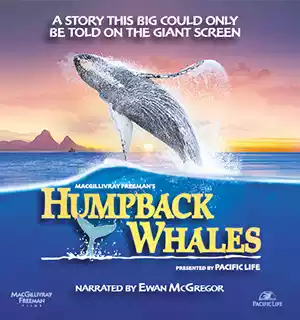
座头鲸 Humpback Whales(EN)Subtitles
| SRT Subtitles download |
1 00:00:03 When I began studying humpback whales almost 50 years ago,
2 00:00:07 there was very little funding for such research.
3 00:00:10 I'd like to thank the pacific
4 00:00:12 life foundation for their unparalleled generosity
5 00:00:15 in supporting the conservation of humpback whales
6 00:00:18 and other marine mammals.
7 00:00:24 Enabling a better future is what pacific life does,
8 00:00:28 and their support of a healthy ocean benefits all of us,
9 00:00:33 whales as well as people.
10 00:01:05 Our planet holds a kind of parallel universe.
11 00:01:15 A place of wonder where giants roam free.
12 00:01:46 For thousands of years,
13 00:01:47 we could only wonder about humpback whales.
14 00:01:53 Now, by exploring their world,
15 00:01:56 we're getting surprising glimpses into their lives.
16 00:02:05 A 40-ton adult appears weightless
17 00:02:07 in its ocean home.
18 00:02:28 Though longer than a school bus,
19 00:02:31 these 50-foot giants are nimble.
20 00:02:39 With a wingspan greater than most Learjets,
21 00:02:42 humpbacks are magnificent acrobats.
22 00:02:53 Often seen in shallow waters,
23 00:02:55 these mammals occasionally dive
24 00:02:57 to a depth of 1,000 feet.
25 00:03:08 Each bump on their heads
26 00:03:10 contains a single stiff hair,
27 00:03:14 which may help them sense their environment.
28 00:03:23 Today, we celebrate them...
29 00:03:27 But it wasn't always so.
30 00:03:34 Whales were hunted for hundreds
31 00:03:35 of years and rendered into oil to light our cities.
32 00:03:42 When whalers developed exploding harpoons,
33 00:03:45 these giants had no chance.
34 00:03:52 We nearly wiped humpback whales off the face of the planet.
35 00:04:01 Then, during the cold war, a U.S. Navy observer,
36 00:04:05 recording the hum of Soviet submarines,
37 00:04:09 heard something mysterious.
38 00:04:13 The otherworldly calls of humpback whales.
39 00:04:21 Humpbacks string their songs together
40 00:04:24 in a continuous river of sound.
41 00:04:28 The music of the deep.
42 00:04:51 In the 1970s, when these recordings were studied
43 00:04:55 by scientists Roger Payne and Scott Mcvay,
44 00:04:59 they recognized that the seemingly random noises
45 00:05:02 were actually precise rhythmic patterns of sound, or "Songs."
46 00:05:09 When record albums were released,
47 00:05:11 the humpbacks' songs changed millions of hearts.
48 00:05:18 People from many nations joined together
49 00:05:21 to support a ban on killing whales.
50 00:05:32 The song of the humpback
51 00:05:34 helped us to begin to understand, finally,
52 00:05:37 that whales are magnificent, complex beings
53 00:05:41 worthy of protection, worthy of life.
54 00:05:46 This was our turning point.
55 00:06:28 The South pacific.
56 00:06:32 The humpback population here was hard-hit by whaling.
57 00:06:43 In Tonga, there were only about 50
58 00:06:46 mature females left.
59 00:06:53 In 1978, when the king of Tonga banned the killing of whales,
60 00:06:58 the humpbacks here slowly began to recover, one calf at a time.
61 00:07:08 Today in Tonga, there are about 2,000 humpbacks,
62 00:07:12 a fraction of what once was, but it's a start.
63 00:07:24 The humpback resurgence
64 00:07:26 has now sparked a whale-watching boom here.
65 00:07:37 The increased tourism
66 00:07:39 has raised the standard of living
67 00:07:41 for the local people, like Ali takau.
68 00:07:45 My grandfather was a whaler.
69 00:07:48 He hunted humpbacks to feed our family.
70 00:07:52 Instead of killing humpbacks,
71 00:07:55 Ali works hard to save them.
72 00:08:02 The future of our humpbacks depends on these children.
73 00:08:07 I tell the kids about the whaling days,
74 00:08:10 so we never have that kind of killing again.
75 00:08:16 My job is taking tourists and scientists
76 00:08:19 out to see the humpbacks.
77 00:08:26 Now these magnificent whales
78 00:08:28 have begun to recover.
79 00:08:31 Each calf is critical to Tonga's fragile resurgence.
80 00:08:38 After a full year of pregnancy,
81 00:08:41 mothers give birth to a single 14-foot baby.
82 00:08:54 What's it like to be a newborn humpback,
83 00:08:57 floating in a vast blue world,
84 00:09:01 where your only landmark is a Mountain of mother?
85 00:09:27 Humpbacks share these idyllic waters
86 00:09:30 with a whole community of marine life.
87 00:09:33 The remora fish come along for the ride.
88 00:09:51 Even when the mother sleeps,
89 00:09:53 the newborns don't stray far from mother's milk.
90 00:10:01 But after a few weeks, the calves get bolder,
91 00:10:04 and they take off on their own.
92 00:10:07 They're so curious.
93 00:10:08 And they've got so much energy.
94 00:10:34 These newborns learn by copying their mothers.
95 00:10:38 In their first year, they double in size.
96 00:11:26 Once they get the hang of it,
97 00:11:27 there's no stopping them.
98 00:11:42 Each calf stays with its mother
99 00:11:44 only about one year to learn about the world.
100 00:11:52 How to migrate thousands of Miles.
101 00:11:58 What to eat and how to find it.
102 00:12:03 Who to trust and who to fear.
103 00:12:09 Whalers like my grandfather
104 00:12:11 once targeted mothers and calves,
105 00:12:14 because they move so slowly.
106 00:12:18 I always loved my grandfather,
107 00:12:20 but he didn't understand the need to stop killing whales.
108 00:12:29 The killing stopped here in Tonga,
109 00:12:31 but not everywhere.
110 00:12:34 Three nations... Japan, Norway and Iceland...
111 00:12:38 Still allow commercial and scientific whaling.
112 00:12:44 Today, fewer people kill whales on purpose,
113 00:12:47 but we now kill them without even knowing it.
114 00:12:50 When a ship collides with a whale,
115 00:12:52 the impact is often fatal.
116 00:12:56 And the number of ships on the world's oceans has doubled
117 00:12:59 in the last 12 years.
118 00:13:04 There is something we can do
119 00:13:05 about these fatal collisions.
120 00:13:08 One solution is to slow down ships,
121 00:13:11 or reroute them
122 00:13:13 to avoid the migratory pathways of whales.
123 00:13:25 Here in Tonga, mothers go for months
124 00:13:28 with almost nothing to eat.
125 00:13:32 To find food,
126 00:13:33 the humpback whales in Tonga head South
127 00:13:36 to the frigid, bountiful waters of Antarctica.
128 00:13:43 Many humpbacks in the north pacific ocean
129 00:13:46 migrate to Alaska.
130 00:14:36 Dr. Fred Sharpe has been studying the behaviors
131 00:14:39 of humpback whales here for the past 25 summers.
132 00:14:49 Most of the time, humpback whales in Alaska
133 00:14:52 feed on krill.
134 00:14:55 These small, shrimp-like crustaceans thrive here,
135 00:14:59 in waters enriched by upwelling currents
136 00:15:02 and glacial nutrients.
137 00:15:04 The tiny krill might be harder to catch
138 00:15:07 if humpback whales had teeth, but they don't.
139 00:15:10 About three hours away, about three hours away.
140 00:15:12 Instead of teeth, humpback whales have baleen.
141 00:15:15 It's a kind of strainer that hangs
142 00:15:17 from the roof of their mouth.
143 00:15:19 It lets the water through, but allows them
144 00:15:22 to trap these tasty morsels, like the fish and the krill.
145 00:15:30 When we're trying to locate big feeding pods,
146 00:15:33 it's almost like you're coming home to family.
147 00:15:36 Fred has studied these particular whales for so long...
148 00:15:40 Bubbles! Bubbles!
149 00:15:41 That he can often tell who's vocalizing just by listening.
150 00:15:52 We know who is who,
151 00:15:53 because each of these whales has a really distinctive tail fluke.
152 00:15:57 They're kind of like a fingerprint.
153 00:15:59 No two are exactly alike.
154 00:16:02 So... I run the prints.
155 00:16:10 This is Melancholy.
156 00:16:14 I've really come to know him over the past 20 years,
157 00:16:17 from studying his behaviors
158 00:16:18 and even sketching him.
159 00:16:24 I often see Melancholy with another male,
160 00:16:27 who we call Vulture.
161 00:16:31 Many whales feed individually,
162 00:16:34 but Melancholy and his crew
163 00:16:35 have learned a really cool strategy.
164 00:16:38 They can capture more fish by working together as a team.
165 00:16:42 When we hear the feeding calls
166 00:16:44 and see the whales group together,
167 00:16:46 we know we're in for quite a show.
168 00:16:51 What happens next
169 00:16:52 is one of the most incredible
170 00:16:54 and complex animal behaviors ever observed.
171 00:17:00 It's called "Group bubble-net feeding."
172 00:17:05 The first step is always the synchronized dive.
173 00:17:15 Some of the whales dive deep
174 00:17:18 underneath the school of herring
175 00:17:20 to drive them up towards the surface.
176 00:17:24 With their long pectoral flippers,
177 00:17:26 they can outmaneuver fast-moving prey.
178 00:17:33 The bubble specialist blows a stream of bubbles,
179 00:17:37 forming a spiraling wall of air
180 00:17:39 that acts like a net to keep the fish from getting away.
181 00:17:45 The designated vocalizer
182 00:17:47 begins to make almost deafening sounds...
183 00:17:51 Scaring the fish up towards the surface.
184 00:18:56 The humpback mouth expands so wide,
185 00:18:59 they could swallow a small car.
186 00:19:13 They can eat up to a ton of food in a single day.
187 00:19:17 That's like 8,000 hamburgers.
188 00:19:33 Well, as it starts to get cold up here in the fall,
189 00:19:36 Melancholy, Vulture and all the other whales begin to leave.
190 00:19:42 They'll travel thousands of
191 00:19:43 miles down to their warm-water breeding areas
192 00:19:46 like Costa Rica, Mexico and Hawaii.
193 00:19:56 Some humpbacks migrate 5,000 Miles
194 00:19:59 one way every year...
195 00:20:03 One of the longest known migrations of any mammal.
196 00:20:10 There are 15 distinct populations of humpback whales,
197 00:20:14 located in all the oceans of the world.
198 00:20:23 They feed in polar and subpolar regions,
199 00:20:27 and breed and give birth in the tropics.
200 00:20:39 Each winter, the Hawaiian islands host
201 00:20:42 the largest gathering of humpbacks in the north pacific.
202 00:20:46 Thousands of whales.
203 00:20:52 Humpbacks may live up to 80 years or more.
204 00:20:58 They seem as curious about us as we are about them.
205 00:21:06 Other whales and dolphins vocalize,
206 00:21:09 but humpbacks make a greater variety of sounds
207 00:21:12 than any other whale...
208 00:21:14 Including grunts...
209 00:21:17 Groans...
210 00:21:19 Thwops...
211 00:21:21 Snorts...
212 00:21:23 And barks.
213 00:21:34 When humpbacks leap, or breach,
214 00:21:37 they make it look easy.
215 00:21:40 No other whale leaps so high so often.
216 00:21:45 We're not exactly sure why they do it,
217 00:21:48 but we're glad they do.
218 00:21:50 ♪ I had a dream so big and loud ♪
219 00:21:53 ♪ I jumped so high I touched the clouds ♪
220 00:22:00 ♪ I stretched my hands out to the sky ♪
221 00:22:02 ♪ We danced with monsters through the night ♪
222 00:22:10 ♪ I'm never gonna look back ♪
223 00:22:11 ♪ Woah, never gonna give it up ♪
224 00:22:14 ♪ No, please don't wake me now ♪
225 00:22:22 ♪ This is gonna be the best day of my life ♪
226 00:22:26 ♪ My li-i-i-i-i-ife ♪
227 00:22:38 ♪ I howled at the moon with friends ♪
228 00:22:41 ♪ And then the sun came crashing in ♪
229 00:22:48 ♪ But all the possibilities ♪
230 00:22:50 ♪ No limits just epiphanies ♪
231 00:22:58 ♪ I'm never gonna look back ♪
232 00:22:59 ♪ Woah, never gonna give it up ♪
233 00:23:02 ♪ No, please don't wake me now ♪
234 00:23:09 ♪ This is gonna be the best day of my life ♪
235 00:23:13 ♪ My li-i-i-i-i-ife ♪
236 00:23:19 ♪ This is gonna be the best day of my life ♪
237 00:23:23 ♪ My li-i-i-i-i-ife ♪
238 00:23:38 On a quiet morning in Hawaii,
239 00:23:40 you can hear hundreds of humpbacks
240 00:23:42 in their hidden world below, all singing at once.
241 00:23:48 A reminder of how their songs
242 00:23:49 began changing our hearts so many years ago.
243 00:24:03 Today, Dr. Jim Darling
244 00:24:04 lowers the hydrophone into the water,
245 00:24:07 just as he did decades
246 00:24:08 ago when Roger Payne first invited him here
247 00:24:11 to record humpback whales.
248 00:24:17 For scientists like Jim,
249 00:24:19 finding singers isn't easy,
250 00:24:22 but there are clues.
251 00:24:28 When whales dive, they leave a slick spot on the surface...
252 00:24:34 What researchers call a footprint.
253 00:24:39 Sometimes when Jim looks
254 00:24:40 down through the footprint, he spots a singer.
255 00:24:50 All the singers in Hawaii
256 00:24:52 start each breeding season singing the same song.
257 00:24:57 Incredibly, when one singer changes his song,
258 00:25:01 they all adopt those same changes.
259 00:25:06 By comparing the latest song against previous versions,
260 00:25:10 Jim can pinpoint exactly what has changed.
261 00:25:14 Jim's colleague, Dr. Meagan Jones,
262 00:25:17 helps him search for those changes in the song.
263 00:25:21 Two years ago, Jim recorded
264 00:25:22 a song with a really distinctive phrase.
265 00:25:25 That's really different.
266 00:25:30 We started calling it "Chuckles" Because it made us laugh.
267 00:25:36 But this year, the chuckles are starting to disappear.
268 00:25:49 After years of study, scientists were surprised to discover
269 00:25:53 the singers were all males.
270 00:26:09 While the males are busy singing, what are the females up to?
271 00:26:18 Dr. Meagan Jones studies the behavior
272 00:26:20 Dof female humpbacks.
273 00:26:23 It's not easy, because they spend
274 00:26:25 90% of their time underwater,
275 00:26:28 out of sight.
276 00:26:31 So she catches only glimpses.
277 00:26:40 One of the most important questions I'm trying to answer
278 00:26:43 is how females choose their mates.
279 00:26:55 No one has ever observed mating between humpbacks.
280 00:27:01 But we often see a male and female
281 00:27:03 resting together.
282 00:27:04 Just before and just after,
283 00:27:06 we see males fighting over the females.
284 00:27:13 The battle-scarred male escort
285 00:27:15 is actually on guard,
286 00:27:16 watching and listening for his rivals.
287 00:27:20 When intruders show up, he tries to fight them off.
288 00:27:49 20 males pursuing just one female.
289 00:27:53 We think the males are vying
290 00:27:54 for the prime spot, closest to the female.
291 00:27:59 The escort will use all kinds of tactics to defend his position.
292 00:28:12 He streams bubbles.
293 00:28:15 He lunges...
294 00:28:17 Charges...
295 00:28:19 And even collides with other males.
296 00:28:28 Is the female leading these males?
297 00:28:31 Or is she being chased?
298 00:28:34 We're not sure...
299 00:28:36 But we think she wants to mate as soon as possible
300 00:28:38 so she can return to Alaska and resume eating.
301 00:28:43 For whales, bigger mothers often make better mothers.
302 00:28:48 She needs to be in the best physical condition
303 00:28:50 when she gives birth the following year.
304 00:29:21 This chase lasted four grueling hours.
305 00:29:27 We think the competition may allow the female
306 00:29:29 the opportunity to select the fittest mate.
307 00:29:34 One day, just as the other male rivals swam away,
308 00:29:38 the male and female pair stayed around
309 00:29:40 and circled our boat for well over an hour.
310 00:30:01 At first, we thought the female was swimming upside down
311 00:30:05 and using the boat to discourage the male.
312 00:30:11 But as we watched the pair
313 00:30:12 circle and dance around each other and us,
314 00:30:15 it became clear that at least in this case,
315 00:30:18 the female was following him
316 00:30:20 as much as the male was following her.
317 00:30:26 Was this courtship?
318 00:30:29 Was she trying to attract him?
319 00:30:34 This is what we think may be happening,
320 00:30:36 but until we see mating,
321 00:30:38 we can just never be sure.
322 00:30:43 For me, these are the best kind of days,
323 00:30:46 when new observations lead to new questions.
324 00:30:56 When Meagan is out studying whales,
325 00:30:59 she sometimes runs into the real
326 00:31:00 dangers they face, like loose, floating debris.
327 00:31:04 Major threat to the animals.
328 00:31:06 More than half of these humpback whales bear scars
329 00:31:09 from being tangled up in ropes and fishing nets.
330 00:31:14 This humpback whale population is growing,
331 00:31:18 but we think worldwide
332 00:31:20 the humpback population may be only 40% of what it was
333 00:31:24 before whaling began.
334 00:31:29 Some of the most serious problems facing whales
335 00:31:31 have no immediate solution.
336 00:31:35 But when individual whales get entangled,
337 00:31:38 some of them can be saved by rescue teams,
338 00:31:41 like the one here in Hawaii.
339 00:31:47 Joe, let's see if we can get underway in five.
340 00:31:49 GPS coordinates set.
341 00:31:55 Most rescues start with a phone call from a boater.
342 00:31:59 Reporting entangled whales
343 00:32:01 is one important way to help humpbacks.
344 00:32:05 Looking for your position.
345 00:32:08 The team caught up to the entangled whale in just under an hour.
346 00:32:22 This young, energetic humpback whale
347 00:32:24 was trailing more than 200 feet of line and buoys behind it.
348 00:32:29 Each entanglement is different, so team leader Ed Lyman
349 00:32:34 has to keep adjusting his strategy.
350 00:32:37 Keep an eye out. We don't want to lose it.
351 00:32:39 If this young whale is not set free by Ed's team,
352 00:32:42 he could die from infection, starvation
353 00:32:45 or even drowning.
354 00:32:48 A key tool is their grapple.
355 00:32:51 That's how they hook onto the trailing gear
356 00:32:54 and then pull themselves close enough to cut the whale free.
357 00:32:59 We attach a transmitter
358 00:33:01 to help track the whale, in case we lose it,
359 00:33:03 and buoys to keep it from diving deep.
360 00:33:08 Even with extensive training,
361 00:33:10 it's dangerous for Ed and Joe to get so close
362 00:33:12 to a huge animal under stress.
363 00:33:16 We work entirely from boats.
364 00:33:18 People have been killed jumping in the water to cut whales free.
365 00:33:23 Let's be careful here!
366 00:33:24 If we hear signs of stress,
367 00:33:26 like a trumpeting blow, we back off.
368 00:33:37 Our pole cam gives us an underwater view
369 00:33:39 and helps us see what's going on.
370 00:33:41 We need to get this gear off.
371 00:33:44 These wounds are... are bad.
372 00:33:47 These young ones, they're unpredictable.
373 00:33:50 Our whale makes a sudden
374 00:33:51 u-turn and snags his gear on a nearby boat,
375 00:33:54 so we race back to cut the boat free.
376 00:33:56 You got it? Okay, good. Next side.
377 00:33:58 As soon as we cut that line, he takes right off.
378 00:34:04 Even dragging all those buoys,
379 00:34:06 the whale is just pulling us too fast.
380 00:34:11 We actually got what the
381 00:34:12 old-time whalers call a nantucket sleigh ride.
382 00:34:16 Let me help you.
383 00:34:21 -Still running hard. -Yeah.
384 00:34:27 We attach a sea anchor to slow it down.
385 00:34:41 Okay, knife is out.
386 00:34:43 You're doing good.
387 00:34:44 Okay, here, I'm right beside you.
388 00:34:46 Finally, the whale slows down enough to give Ed a clean angle.
389 00:34:51 So he moves in for the cut.
390 00:34:52 Perfect. Right there.
391 00:34:54 And... here comes.
392 00:34:58 Okay!
393 00:35:04 -Okay. -Oh, nice slice!
394 00:35:20 It all went their way today,
395 00:35:22 but it doesn't always work out.
396 00:35:29 Even Ed's heroic team
397 00:35:31 can't save every whale.
398 00:35:33 But you and I can help reduce the number of entangled humpbacks.
399 00:35:39 Encourage the use of whale-safe gear,
400 00:35:42 and keep debris out of the ocean.
401 00:35:51 I'm in awe of humpback whales.
402 00:35:56 For centuries, men in boats
403 00:35:58 brought them pain and death.
404 00:36:01 It brings us such joy to
405 00:36:03 flip that around and bring them life instead.
406 00:36:13 It took hundreds of years
407 00:36:15 for people all across the world to wake up
408 00:36:18 and hear the song of the humpbacks.
409 00:36:23 In the early days, humpbacks were known as our guardians.
410 00:36:29 Now it's our turn.
411 00:36:47 Future generations of
412 00:36:48 scientists have their work cut out for them.
413 00:36:55 Each new insight scientists gain into these remarkable whales
414 00:36:59 helps us protect them against the growing threats they face.
415 00:37:13 Oceans cover 71% of our planet,
416 00:37:17 and humpbacks roam them all.
417 00:37:24 Just one look in their eye will tell you
418 00:37:27 we have much more to learn about their world.
419 00:37:32 And to think, we nearly missed that chance.
420 00:38:16 Best Day Of My Life - American Authors
421 00:38:20 ♪ I had a dream so big and loud ♪
422 00:38:23 ♪ I jumped so high I touched the clouds ♪
423 00:38:30 ♪ I stretched my hands out to the sky ♪
424 00:38:32 ♪ We danced with monsters through the night ♪
425 00:38:39 ♪ I'm never gonna look back ♪
426 00:38:41 ♪ Woah, never gonna give it up ♪
427 00:38:43 ♪ No, please don't wake me now ♪
428 00:38:47 ♪ Two, three, four ♪
429 00:38:52 ♪ This is gonna be the best day of my life ♪
430 00:38:56 ♪ My li-i-i-i-i-ife ♪
431 00:39:02 ♪ This is gonna be the best day of my life ♪
432 00:39:06 ♪ My li-i-i-i-i-ife ♪